
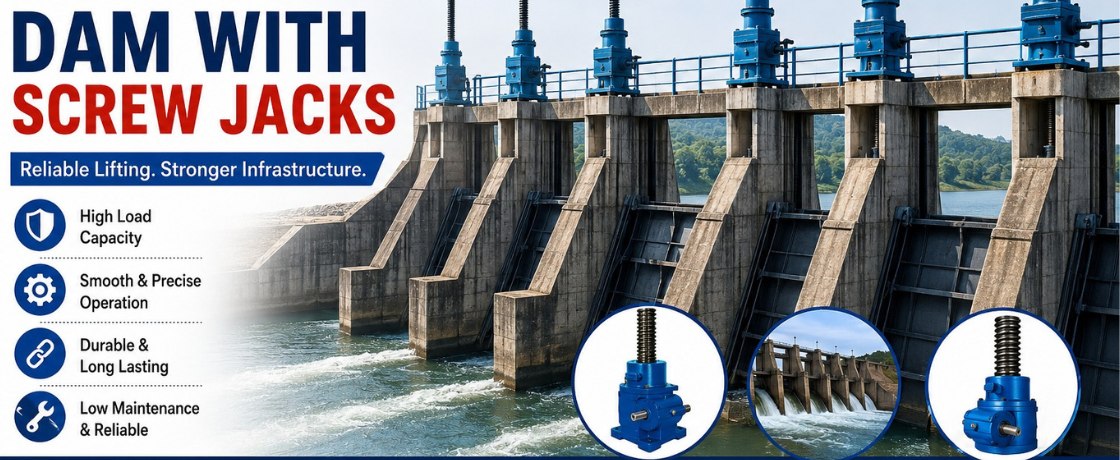
Jyoti Hydraulic manufactures dependable lifting solutions for dam gates, canal regulators, barrages, spillways, and other water-control structures. In these applications, a Worm Gear Screw Jack converts rotary input from a handwheel, motor, or gearbox into controlled linear movement. This allows heavy gates to be raised, lowered, and held at the required position without sudden motion.
Dam gate operation is not a simple lifting task. The mechanism must handle the gate’s dead weight, water pressure, friction in guide channels, debris accumulation, uneven loading, and outdoor exposure. A correctly selected screw jack system provides the mechanical strength and positioning accuracy needed for safe water regulation.
Role of Screw Jacks in the Water Infrastructure Industry
India’s irrigation networks, hydropower plants, reservoirs, flood-control projects, and wastewater facilities depend on reliable gate operating systems. These gates control how much water enters canals, passes through turbines, moves downstream, or is released during high reservoir levels.
Mechanical screw jacks are widely used because they are robust, easy to inspect, and suitable for installations where hydraulic leakage is undesirable. They can be designed for manual operation at smaller sites or integrated with electric motors and control panels for automated projects.
Experienced Worm Gear Screw Jack Manufacturers in India generally study the complete gate arrangement before recommending a system. Selecting a jack only on the basis of gate weight may result in inadequate capacity or premature component wear.
How a Worm Gear Screw Jack Works
A worm gear screw jack consists of a worm shaft, worm wheel, lifting screw, bearings, housing, seals, and a lubrication system. When the worm shaft rotates, it drives the worm wheel. This rotation is converted into the linear travel of the lifting screw or travelling nut, depending on the selected design.
The worm gear arrangement provides high mechanical reduction. As a result, relatively low motor torque can move a much heavier gate. The reduction also supports slow and controlled travel, which is important when regulating water discharge.
Two common configurations are used:
Translating Screw Type
The screw moves vertically while the gearbox remains fixed. This design is suitable where adequate space is available above or below the jack.
Rotating Screw Type
The screw rotates while a travelling nut moves along its length. It may be preferred when the screw must remain axially fixed or when the installation layout requires a moving nut arrangement.
Important Engineering Considerations
The rated lifting capacity should exceed the calculated operating load with an appropriate safety margin. Engineers must consider:
- Gate weight and buoyancy
- Hydrostatic pressure on the gate
- Guide and seal friction
- Starting torque
- Required lifting stroke
- Operating speed
- Number of operating cycles
- Possibility of uneven loading
- Outdoor temperature and corrosion exposure
For wide gates, two or more screw jacks may be installed. These units must move together so that one side of the gate does not rise faster than the other. Mechanical synchronization can be achieved through connecting shafts, couplings, bevel gearboxes, and a common drive motor.
Misalignment places additional side load on the lifting screw and bearings. Therefore, accurate mounting, rigid foundations, and proper shaft alignment are essential during installation.
Applications in Dam Water Control
Worm gear screw jacks are commonly used for:
- Vertical lift gates
- Sluice gates
- Spillway gates
- Intake and outlet gates
- Canal head regulators
- Barrage gates
- Irrigation control gates
- Stop-log lifting systems
- Water-treatment plant gates
They are suitable for both new water infrastructure and the modernization of older gate operating systems.
Benefits of Worm Gear Screw Jacks
Controlled Gate Movement
Slow and uniform lifting allows operators to adjust water flow accurately instead of opening or closing a gate abruptly.
High Load Capacity
The worm reduction mechanism generates substantial lifting force from comparatively low input torque.
Reliable Load Holding
Depending on the screw lead, efficiency, vibration, and operating conditions, the mechanism may resist back-driving. However, self-locking should not be assumed without engineering verification. Brakes or additional locking systems may be required for critical installations.
Lower Risk of Fluid Contamination
Unlike hydraulic systems, mechanical screw jacks do not depend on pressurised oil for lifting. This removes the risk of hydraulic fluid leakage near water sources.
Simple Inspection
Gear housings, screws, shafts, couplings, and lubrication points can be included in a planned inspection schedule.
Buying Guide: Selecting the Right Screw Jack
When choosing a Screw Jack Manufacturer in India, provide complete application data rather than requesting a jack only by tonnage. The manufacturer should know the gate dimensions, operating load, stroke, lifting speed, duty cycle, number of jacks, mounting orientation, and environmental conditions.
Also evaluate:
- Material and heat treatment of the lifting screw
- Gear ratio and gearbox efficiency
- Static and dynamic load ratings
- Corrosion-protection system
- Motor and brake arrangement
- Manual emergency operation
- Limit switches and overload protection
- Availability of spare parts
- Installation and commissioning support
A custom-engineered system is often more reliable than adapting a standard jack to an unsuitable gate arrangement.
Future Trends
Modern dam projects are gradually combining mechanical screw jacks with digital controls. Limit sensors, load monitoring, position feedback, motor-current monitoring, and SCADA connectivity help operators identify abnormal resistance or uneven gate movement.
Predictive maintenance will also become more common. Monitoring vibration, temperature, lubrication condition, and motor load can help maintenance teams detect wear before a gate becomes difficult to operate.
Conclusion
A properly engineered Worm Gear Screw Jack provides strength, accuracy, and dependable linear movement for dam water-control systems. Its success depends on correct load calculation, synchronized operation, structural alignment, corrosion protection, and regular lubrication.
Jyoti Hydraulic supports irrigation, dam, barrage, and industrial water-management projects with application-specific screw jack solutions designed around actual site conditions.
Frequently Asked Questions
Can multiple screw jacks lift one dam gate?
Yes. Multiple jacks can be connected through shafts and bevel gearboxes to maintain synchronized movement across a wide gate.
Are worm gear screw jacks completely self-locking?
Not always. Self-locking depends on screw lead, efficiency, lubrication, vibration, and load conditions. A brake or mechanical locking device may be necessary.
Can a screw jack operate manually during a power failure?
Yes. A manual handwheel or emergency operating arrangement can be included during system design.
How is the correct capacity selected?
Capacity is calculated from gate weight, water pressure, friction, starting load, number of jacks, and the required safety factor.
How often should the system be maintained?
Inspection frequency depends on operating cycles and site conditions. Lubrication, screw condition, alignment, seals, couplings, and fasteners should be checked periodically.
Get a Technical Recommendation
Need a reliable lifting system for a dam gate, barrage, canal regulator, or water-control project?
Contact Jyoti Hydraulic to discuss your load, stroke, speed, installation layout, and operating conditions. Request a quotation or receive expert guidance for selecting the correct screw jack system.
📞 +91 9541424317


